Last time we spoke to Zazzle artist John Dyer, he was deep in the Amazon Rainforest on the first chapter of his project Last Chance to Paint, and since then he has also traveled to Borneo to visit the orangutans. In both locations, John and his team painted endangered environments to highlight what we stand to lose by the effects of deforestation and climate change. Through satellite and social media, they connected with hundreds of school children around the world, and encouraged them to create their own art inspired by the wildlife and tribal cultures they saw.
Everyone who took part was invited to submit their creations into the Last Chance to Paint Art Awards, sponsored by Zazzle. Last week we were excited to announce the winners who will soon receive Zazzle products custom made with their own artwork!
With the prizes made and on their way to the budding young artists, we spoke to John again to hear more about the project so far!
Can you give us a quick recap of the two chapters last year? Why did you choose each location?
Chapter one of Last Chance to Paint was based in the Amazon Rainforest of Brazil with the Yawanawá tribe. Chapter two was in the Borneo rainforest with the Penan tribe and the Orangutan Foundation. It provided us with unique access to a highly secure, government-protected rainforest to meet and paint orangutans in the wild.
I selected both of these locations with great care and lots of research, but they also relied on the team’s personal connections with the Yawanawá and Penan tribes. The rainforests are vital for us all. When we damage the rainforests and the tribes, we damage ourselves. Last Chance to Paint aims to bring together and celebrate what we stand to lose: plants, peoples, and animals. Visiting tribal communities is a perfect place to start, and through the use of video, sent via satellite, and questions from schools, received via satellite, we can involve thousands of children in the moment.
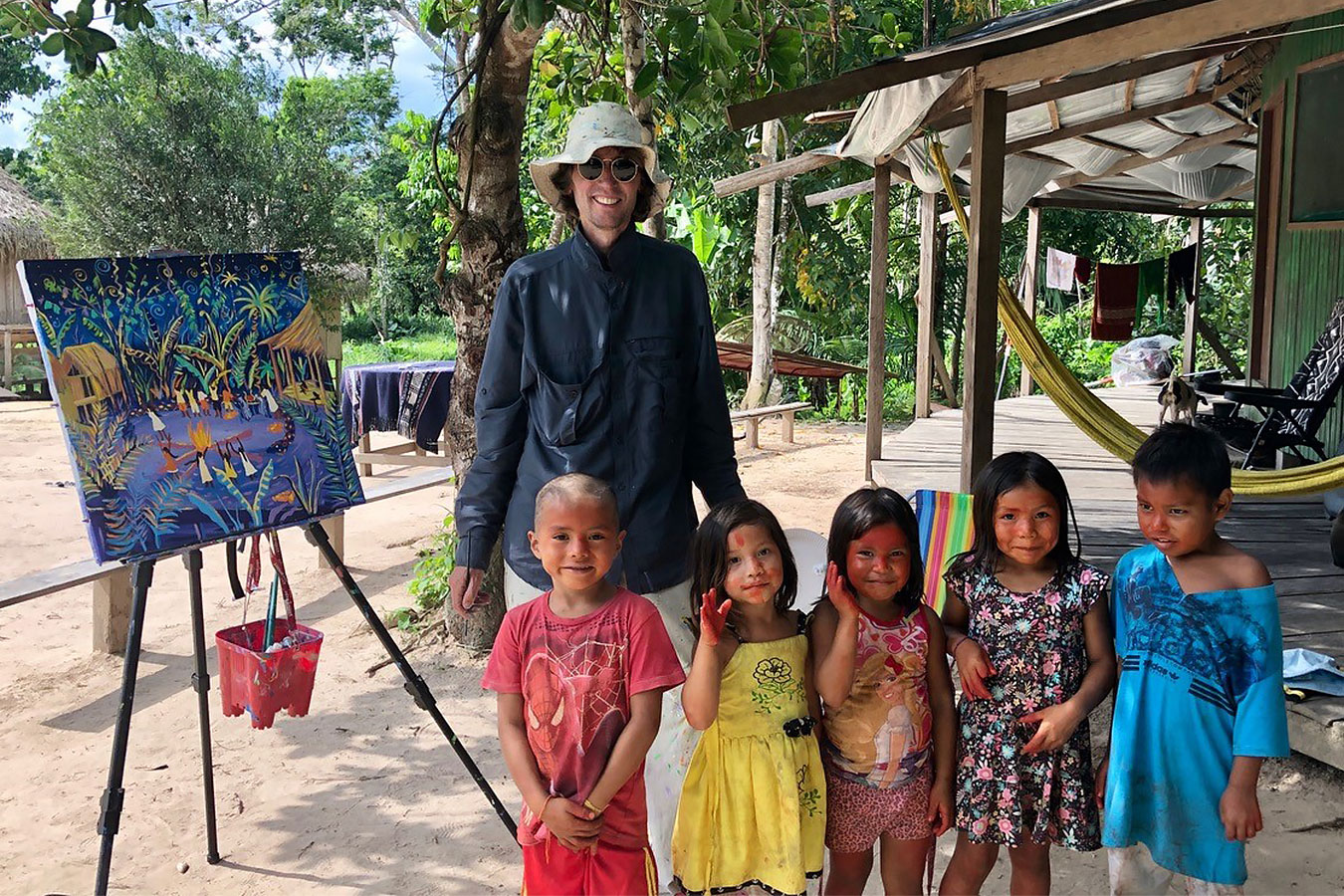
Chapter one, with the Yawanawá tribe in the Amazon, focused on the spirituality of the tribe, and their deep visual connection to the rainforest. The animals and insects and the shapes of the leaves all have spiritual forms and even the children of the tribe draw the spiritual versions of these. It was absolutely fascinating to discover this and to see how deeply connected the whole tribe is to the rainforest, emotionally, physically, spiritually, and visually. I had the great joy of being able to paint with an Amazon Indian artist Nixiwaka Yawanawá. We stood side by side painting large acrylic paintings deep in the Amazon. Magical.
Chapter two took me and the Last Chance to Paint team to meet the Penan tribe in the rainforest of Borneo and then far south in Borneo to live with and paint orangutans. Borneo has one of the most amazing rainforests on the planet, and to be able to spend time with one of the last tribes to have been nomadic, and to meet their elders and share music and art was very special. Eighty percent of the rainforest in Borneo has been lost in the last twenty years, so time is running out to explore and celebrate what we all stand to lose.
What were your highlights from each chapter?
There are so many highlights and it has all been captured in the daily vlogs we sent ‘live’ from the rainforests. For me personally, it was amazing to enable the tribal children to paint and to react to their rainforests and to then publish their art on the Last Chance to Paint Gallery for everyone to see. The tribal ceremonies of the Yawanawá are extraordinary and they take you to another world. Sitting around a fire in the tribal village of Mutum in the Amazon with tribal chanting, face and body decorations, and the music was a once in a lifetime experience. The extraordinary trees and buttress roots with toucans flying overhead, enormous butterflies of all colors, and the constant hum of the forest is fantastic.
In Borneo, it was the beguiling orangutans that really captivated me. These wonderful and noble creatures are on the brink of extinction, and to be allowed by the Indonesian government to join the Orangutan Foundation in their protected area was so special. All of the orangutans I met have had very difficult pasts, but now have wonderful futures and it is this positivity and hope that I feel art can really capture and celebrate.
What did you paint yourself in each of the chapters? Do you have any favorite paintings?
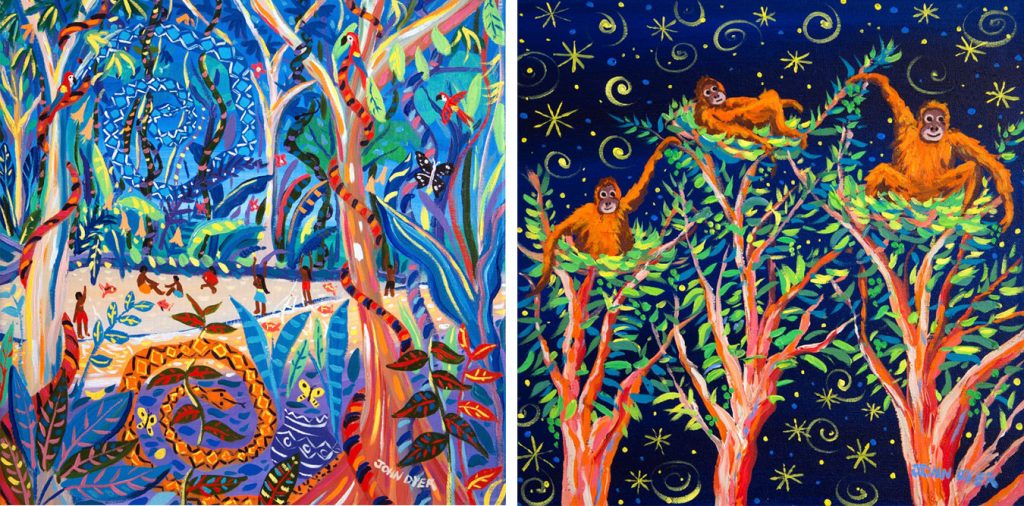
All of the paintings I made are really special to me as they are all unique and were created in extraordinary and remote locations. In the Amazon, I painted the rainforest and tribe combined with their rainforest spirits and spiritual animals. A particular favorite of mine is “The Sky Snake Ashuinka and Ground Snake Runua,’ which explores the two Yawanawá spiritual snakes that dwell in the sky and ground.
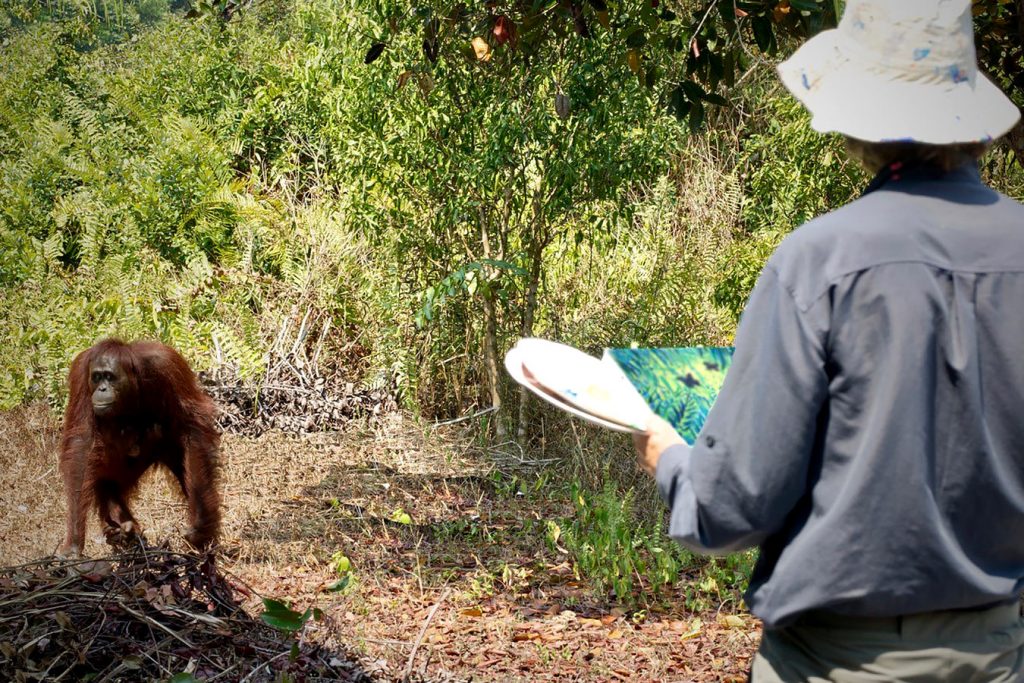
In Borneo, I think I captured the future story of the orphaned orangutans in my painting ‘Stargazing Orangutans.’ The orphaned orangutans, who lost their homes and mothers due to palm oil plantations, have to be taught how to find food, avoid dangers, and to make new nests for themselves every night as they would in the wild. My painting was created in the rainforest as they clambered above my head in the trees collecting fruit and leaves.
How did you select the winners of the Art Awards?
The Last Chance to Paint Art Awards is our way of recognizing some of the best children’s art celebrating the natural world. We assembled an esteemed panel of judges to look carefully at all the submissions. I was joined on the panel by Sir Tim Smit KBE, the co-founder of the Eden Project and Virginia McKenna OBE the co-founder of the Born Free Foundation, Kate Stephenson the educational editor of the National Geographic Kids magazine. I am also very grateful to yourselves at Zazzle for joining us in the serious but joyous task of selecting our award winners for this year.
A real highlight was having award winners from the UK, China, United Arab Emirates, Brazil, and Borneo, and to see all of those children and hundreds of others using the universal language of art to communicate their love and care of the planet and their futures.
What’s next? Are there any details on the next chapter of the project?
We are planning Chapter three now and it will be based in Africa, where I will be embedded with the amazing Born Free team in Kenya. ‘Precious Africa’ will be focusing on the Maasai people and the animals of the Amboseli and Meru national parks, in the shadow of Mount Kilimanjaro. I will have a special focus on megafauna. There are now only two Northern White rhinos left on Earth, so this really is a last-chance-to-paint moment and one that will be very poignant for everyone who follows and takes part in the next adventure. I hope that many hundreds of schools from around the world will take part in this free opportunity. Making a piece of art not only celebrates the ecosystem of Africa but in the process bonds those children to the natural world so they tread gently as they grow.
The award winners from the first two chapters have had their winning art turned into Zazzle products such as mugs, notebooks, wallets, clocks, and pencil cases.
If you would like your family or school to take part in the next chapter, all you have to do is to register interest here! We can’t wait to see and hear about the next chapter ‘Precious Africa.’

Matilda is Marketing Manager in the International Team, bringing Zazzle to customers everywhere from Sydney to Stockholm.