
May is Asian American and Pacific Islander (AAPI) Heritage Month, and Zazzle would like to take this opportunity to reflect on the historical experience and highlight the cultural contributions of Asian Americans, Native Hawaiians, and Pacific Islanders in the U.S. The AAPI community is among the largest and fastest growing in the country: an estimated 25.2 million people identified as Asian alone-or-in-combination in 2023, and 1.8 million described themselves as Native Hawaiian and Other Pacific Islander (NHPI) in the same year, according to the U.S. Census.
Despite the prevalence of this community, however, their visibility – both prior and into the twenty-first century – has not been proportionate. AAPI Heritage Month seeks to address this imbalance, with the Smithsonian Institution, Library of Congress, National Park Service, and other organizations united in their campaign to better represent a group that constitutes nearly 8% of our population. With the 2026 theme, “Power in Unity: Strengthening Communities Together” in mind, this article pays tribute to the vital role of Asian Americans and Pacific Islanders in the U.S., honoring their diverse histories and cultures. It also tracks the development of AAPI Heritage Month from 1977 and illustrates ways in which you can support members of this community in 2026 – among them our Independent Creators, whose thoughtful perspectives and creative work are featured here.
What Does AAPI Mean?
It can be helpful to have an umbrella term like ‘AAPI’: the AAPI Equity Alliance, for example, uses it to advocate for Asian Americans and Pacific Islanders at large. However, we must take care not to “reduce AAPI experience to a monolith,” as The Solutions Project has written, or to “neglect communities under the umbrella.” AAPI encompasses more than 50 ethnic groups, over 75 countries, and 100+ languages – there is no single, centralized AAPI history.
A representative understanding of the term includes individuals with heritage in East Asia, South Asia, and Southeast Asia. It also comprises Pacific Islander regions such as Polynesia, Micronesia, and Melanesia. In order to achieve a more nuanced, global understanding of AAPI heritage, resources like “A Different Asian American Timeline” can be useful: rather than focusing “only on events related to people who arrived in the United States from Asia,” it chronicles 600 years of history, situating the Asian-American experience within a broader geographical context.
When Did AAPI Heritage Month Begin?
The origins of AAPI Heritage Month can be traced to Capitol Hill staffer Jeanie Jew in 1977. As a fourth-generation Chinese American, she was “concerned about the lack of acknowledgement for the contributions of Asian Americans to the country during [1976’s] bicentennial celebrations.” Upon sharing her thoughts with Rep. Frank J. Horton and his Chief of Staff Ruby Moy, joint resolutions were introduced to designate the start of May as “Pacific/Asian American Heritage Week.” A subsequent resolution approved in 1978 became Pub. L. No. 95–419, which in turn directed that a presidential proclamation be issued regarding “Asian/Pacific American Heritage Week.” The following year, President Jimmy Carter heralded the inaugural celebration, stating that Asian and Pacific Americans “[had helped create] a dynamic and pluralistic America, with their enormous contributions to our science, arts, industry, government, and commerce.”
That AAPI Month takes place in May is also no coincidence. The timing served to commemorate the arrival of the first documented Japanese immigrants in the U.S. (May 7, 1843) and the completion of the transcontinental railroad (May 10, 1869); the latter was a feat of engineering only made possible by approximately 15–20,000 Chinese workers. The importance of these two dates was further recognized by President George H. W. Bush with Proclamation 6130, which established May 1990 as “Asian/Pacific American Month.” This was later made permanent by Congress in 1992. It must be remembered, however, that Asian and Pacific Islander history in the U.S. is replete with meaningful moments and unique stories, and thus our celebration of AAPI heritage must extend year-round. It should also take diverse forms, in an attempt to reclaim any forgotten histories; take, for instance, Jeffrey Yoo Warren’s 3D reconstructions of the Chinatown neighborhood which once existed in Providence, Rhode Island.
Our AAPI Creators
The importance of AAPI Heritage Month is best understood through members of the community itself. At Zazzle, we are privileged to host many AAPI Creators on our marketplace; in the lead-up to AAPI Month this year, we reached out to these contributors, asking them the following: “The theme of this year’s AAPI Month is ‘Power in Unity: Strengthening Communities Together.’ What are some ways in which people can support and strengthen the AAPI community?”

“One of the ways to support and strengthen the AAPI community is to promote Asian cultural activities. Organize and attend cultural events, such as the Lunar New Year, Mid-Autumn festival, Qing Ming festival, Chong Yang Festival, Dragon Boat Festival and more. Educate the younger generation about the meaning of and reasons behind traditional culture: the Wedding Tea Ceremony, the Longevity birthday celebration, worshiping Ancestors, emphasizing respect in funeral rituals and exchanging red envelopes. Take part in cultural practices, such as Calligraphy, Kung Fu, Tai Chi, Mahjong, fan dancing and lion dancing. Reduce racism between cultures. Learn about the history of different cultures and be open-minded and respectful.” – Tracy T

“Read, watch, and listen centering AAPI experiences. Reach out to AAPI friends, family, and colleagues to offer support through listening, small gestures, and keeping an open mind.” – Mary Frances Therese Rojas

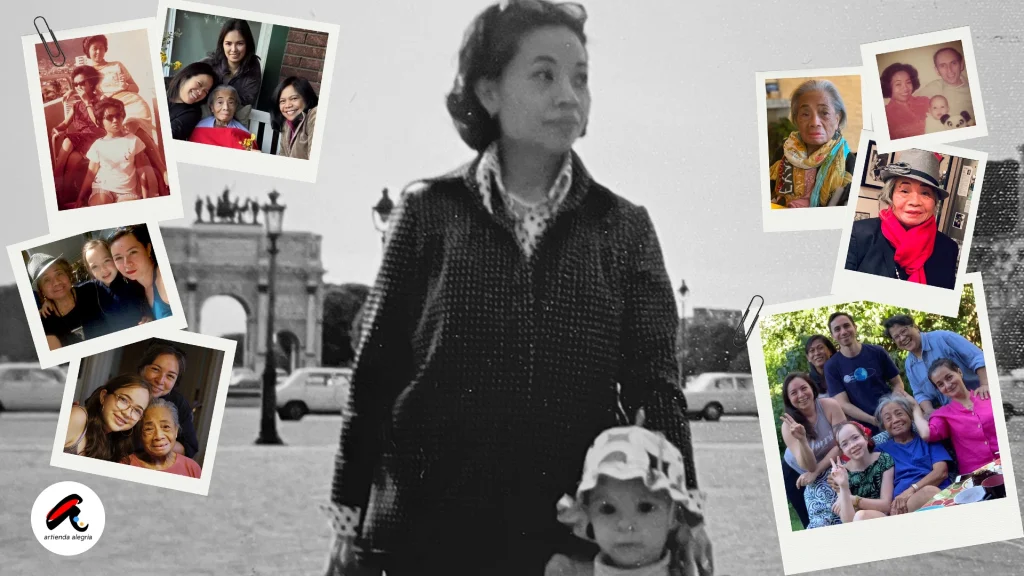
“It is an honor to share my voice as part of this year’s theme, Power in Unity: Strengthening Communities Together. I’ve attached a photo montage of the incredible women referenced in my submission. To me, the heart of “Power in Unity” is kapwa – the Filipino idea that we belong to one another; that we’re connected, responsible for each other, and stronger together. Supporting the AAPI community looks like embodying that shared humanity: showing up, checking in on your people, helping a stranger without being asked, and extending compassion and hospitality in everyday ways. It also means supporting AAPI creators, caregivers, and small businesses, and making space for our stories, be they joyful, complicated, funny, and everything in between – and making sure they are heard and seen both within and beyond our communities. It means honoring our elders and appreciating those who hold everything down—parents, ninangs, titas, lolas, cousins, and neighbors – whose love shows up as meals, hugs, jokes, singing, advice (whether we want it or not!), and “take more, take more.” So, basically, it’s community… with snacks. I would also say that real strength, unity, and support aren’t big showy moments, that instead, they are something much simpler and just as powerful: gathering around a table, sharing food, laughing or crying, and remembering we’re not meant to do any of this life alone.” – Aimee Schneider
Speaking to NPR in 2023, civil rights campaigner Cynthia Choi noted that “[AAPI people] are a part of this fabric – a part of this country,” and it is that fact which we honor and celebrate today at Zazzle. To learn more about AAPI culture this May, you could visit a museum or a virtual exhibit, support local AAPI-owned businesses, read books that center on Asian or Pacific American experiences, or attend any panels or lectures taking place in your area.

Zazzle Ideas hosts a wide range of content experts, contributing knowledge & inspiration around current events. Learn more about what our writers have to say, exclusively here on Zazzle Ideas.