Sale Price $3.96.
Original Price $4.94 Comp. value
per card
You save 20%
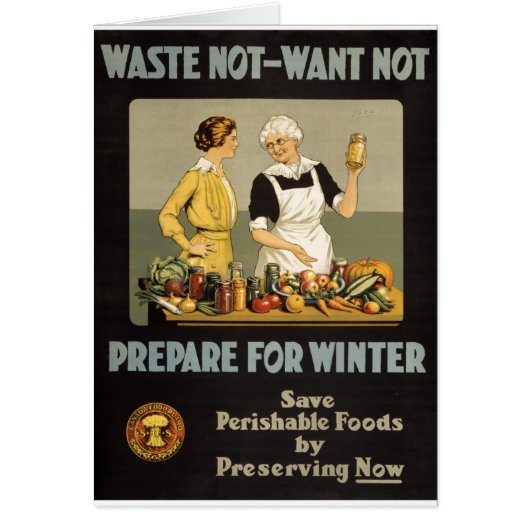
World War 1 poster. Waste not, want not.
View Product DetailsAbout Cards
Sold by
About This Design
World War 1 poster. Waste not, want not.
"Waste not, want not. Prepare for winter. Save perishable foods by preserving now." Date Between 1914 and 1918. Food waste is "any food substance, raw or cooked, which is discarded, or intended or required to be discarded", according to the legal definition of waste by the EU Commission. Since there are several definitions of waste, equally many definitions of food waste exist; professional bodies, including international organizations, state governments and secretariats may formally have their own defintions. The definition of waste is a contended subject, often defined on a situational basis, so it follows that food waste is the same; professional bodies, including international organizations, state governments and secretariats may formally have their own definitions. In 1975, the European Commission, the executive branch of the European Union, legally defined waste for countries in the Union as: "any substance or object which the holder disposes of or is required to dispose of pursuant to the provisions of national law in force". This directive (75/442/EEC) was amended in 1991 (by 91/156), with the addition of "categories of waste" (Annex I) and the omission of any reference to national law. Annex I categorises types of waste by how they occur, and some categories appear specific to certain waste types; "Products whose date for appropriate use has expired" targets food waste, with "date" referring to the expiry date of a food. The United States Environmental Protection Agency defines food waste for the United States as being: "Uneaten food and food preparation wastes from residences and commercial establishments such as grocery stores, restaurants, and produce stands, institutional cafeterias and kitchens, and industrial sources like employee lunchrooms". Although it is a nation-wide agency, states are free to define food waste individually, according to policies, preference and other definitions, though many choose not to. Overall, the definition of food waste can vary in many ways, including, but not limited to: what food waste consists of, how food waste is produced, and where/what it is discarded from/generated by. The definition can be varied and complicated by other issues; certain groups do not consider (or have traditionally not considered) food waste to be a waste material, due to its applications; some definitions of what food waste consists of are based on other waste definitions (e.g. agricultural waste), and which materials do not meet their definitions. Prevention One way of dealing with food waste is to reduce its creation. This attitude has been promoted by campaigns from advisory and environmental groups, and by concentrated media attention on the subject. Consumers can reduce their food waste output at point-of-purchase and in their home by adopting some simple measures; planning when shopping for food is important, spontaneous purchases are shown as often the most wasteful; proper knowledge of food storage reduces foods becoming inedible and thrown away. Collection In areas where waste collection is a public function, food waste is usually managed by the same governmental organization as other waste collection. Most food waste is combined with general waste at the source. Separate collections have the advantage that food wastes can be disposed of in ways not applicable to other wastes. From the end of the 19th century through the middle of the twentieth century, many municipalities collected food waste (called "garbage" as opposed to "trash") separately. This was typically disinfected by steaming and fed to pigs, either on private farms or in municipal piggeries. Separate kerbside collection of food waste is now being revived in some areas. To keep collection costs down and raise the rate of food waste segregation, some local authorities, especially in Europe, have introduced "alternate weekly collections" of biodegradable waste (including e.g. garden waste), which enable a wider range of recyclable materials to be collected at reasonable cost, and improve their collection rates. However, they result in a two week wait before the waste will be collected. So there is criticism that, particularly during hot weather, food waste rots and stinks, and attracts vermin. Much kitchen waste also leaves the home through garbage disposal units.

Customer Reviews
4.9 out of 5 stars rating7.3K Total Reviews
7,347 Reviews
Reviews for similar products
5 out of 5 stars rating
By K N.November 10, 2018 • Verified Purchase
Folded Card, Size: Standard (5" x 7"), Paper: Signature Matte
Creator Review
What strikes me most about this card on opening the envelope is the stunning color and the beautiful close up. The card itself lends it to a feel good touch as well so its a lot of senses perked! My customers like it as well! The color is stunning! The closeup is very nicely detailed and just perfectly awesome! Could not ask for better printing!
5 out of 5 stars rating
By NavinJOSHI s.August 13, 2013 • Verified Purchase
Folded Card, Size: Standard (5" x 7"), Paper: Signature Matte
Creator Review
Unusual color scheme is clearly visible on the art. Not many artist try to emphasize that as an artist they can see things different so long they look beautiful. This is an UNIQUE image.
I bought a bunch of 34 different cards as like to give a different card to each of my friend which makes it very personal. When friends talk with each other, they appreciate the gesture all the more. Also I took advantage of volume pricing. Thanks to Zazzle for allowing to order even one card. I recommend people to buy from Zazzle. Pure Joy. Excellent printing and color tones.
5 out of 5 stars rating
By K N.November 10, 2018 • Verified Purchase
Folded Card, Size: Standard (5" x 7"), Paper: Signature Matte
Creator Review
iI am overjoyed and tickled pin with this card!! he minute I oened the envelope and saw it it just raised my spirits! Love the feel of the paper, its high quality all the way! And my customer really appreciaed it!! And topping that paired up with the labels was a perfect match! The color and the entire card and design is perfect! Better than I hoped and so awesome! My customer appreciiated it too! And the labels matched in color perfecty too!
Tags
Other Info
Product ID: 137134552443342153
Created on: 2/3/2010, 12:32 PM
Rating: G
Recently Viewed Items